Cap'n Games, Inc.
INT: INTELLIVISION CONSOLE
INT: INTELLIVISION CONSOLE
Variant Definitions
Variant Definitions
Key: Variant Title = Description of Expected Goods
GAME ONLY = It's the Game Disc/Cart Only
GAME WITH BOX/INSERT = Game Disc/Cart with original Box Artwork Insert, correct color case (may be replacement).
GAME WITH BOOK/BOX/INSERT = Game Disc/Cart with Original Instruction Manual and Artwork Insert, correct color case (may be replacement)
GAME BOX/INSERT ONLY = Just The Artwork - NO Game (you should have it and need the artwork insert for it).
GAME BOOK/MANUAL ONLY = Same, just the original manual the manufacturer put in there.
BRAND NEW SEALED = We strive to notify you of any rips or tears in cellophane wrapping. If perfection is wanted, PLEASE call us before hitting order.
Please assume all items have a company price sticker affixed to each item. We use "removable" stickers and avoid stickering cardboard.
No Used Items will arrive with other inserts (supplied maps, warranty cards, posters, stickers, plastic wrap, cardboard or foam inserts) - some do, but don't plan on it since many people threw things away back then.
Brand New Sealed items have manufacturers warranty which are applied first, as applicable (esp. Atari).
Not stocked? Choose the Out of Stock Variant, Scroll and Click Notify Me! The system will email you when restocked automatically! :)
Couldn't load pickup availability
Product Description |
|
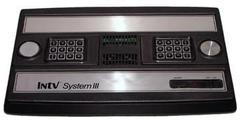
The Intellivision was developed at Mattel in Hawthorne, California, along with the Mattel Electronics line of handheld electronic games. Mattel's Design and Development group began investigating a home video game system in 1977. It was to have rich graphics and long-lasting gameplay to distinguish itself from its competitors. Mattel identified a new but expensive chipset from National Semiconductor and negotiated better pricing for a simpler design. Its consultant, APh Technological Consulting, suggested a General Instrument chipset, listed as the Gimini programmable set in the GI 1977 catalog. The GI chipset lacked reprogrammable graphics and Mattel worked with GI to implement changes. GI published an updated chipset in its 1978 catalog. After having chosen National in August 1977, Mattel waited for two months before ultimately choosing the proposed GI chipset in late 1977. A team at Mattel, headed by David Chandler, began engineering the hardware, including the hand controllers. In 1978, David Rolfe of APh developed the onboard executive control software named Exec, and with a group of Caltech summer student employees programmed the first games. Graphics were designed by a group of artists at Mattel led by Dave James. The Intellivision was introduced at the 1979 Las Vegas CES in January as a modular home computer with the Master Component priced at US$165 and a soon-to-follow Keyboard Component also at $165 (equivalent to $690 in 2023). At Chicago CES in June, prices were revised to $250 for each component. A shortage of key chips from manufacturer General Instrument resulted in a limited number of Intellivision Master Components produced that year. In Fall 1979, Sylvania marketed its own branded Intellivision at $280 in its GTE stores at Philadelphia, Baltimore, and Washington, D.C. On December 3, Mattel delivered consoles to the Gottschalks department store chain headquartered in Fresno, California, with a suggested list price of $275. The Intellivision was also listed in the nationally distributed JCPenney Christmas 1979 catalog along with seven cartridges. It was in stores nationwide by mid-1980 with the pack-in game Las Vegas Poker & Blackjack and a library of ten cartridges. Mattel Electronics became a subsidiary in 1981. Though the Intellivision was not the first system to have challenged Warner Communications's Atari, it was the first to have posed a serious threat to the market leader. A series of advertisements starring George Plimpton used side-by-side game comparisons to demonstrate the superior graphics and sound of Intellivision over the Atari 2600. One slogan called Intellivision "the closest thing to the real thing". One such example compared golf games; where the 2600's games had a blip sound and cruder graphics, the Intellivision featured a realistic swing sound and striking of the ball and a more 3D look. In 1980, Mattel sold out its 190,000 stock of Intellivision Master Components, along with one million cartridges. In 1981, more than one million Intellivision consoles were sold, more than five times the amount of the previous year. The Intellivision Master Component was branded and distributed by various companies. Before Mattel shifted manufacturing to Hong Kong, Mattel Intellivision consoles were manufactured by GTE Sylvania. GTE Sylvania Intellivision consoles were produced along with Mattel's, differing only by the brand name. The Sears Super Video Arcade, manufactured by Mattel in Hong Kong, has a restyled beige top cover and detachable controllers. Its default title screen lacks the "Mattel Electronics" captioning. In 1982, Radio Shack marketed the Tandyvision One, Similar to the original console but with the gold plates replaced with more wood trim. In Japan, Intellivision consoles were branded for Bandai in 1982, and in Brazil there were Digimed and Digiplay consoles manufactured by Sharp in 1983. |
Share with those who care about the Love of Retro!